CRISPR/Cas9 gene editing has transformed how scientists study, modify, and potentially correct genetic information. What once required years of complex laboratory work can now be achieved with remarkable precision and efficiency. This technology is reshaping medicine, agriculture, biotechnology, and fundamental biological research.
From treating inherited diseases to improving crop resilience, CRISPR/Cas9 gene editing offers tools that were unimaginable only a decade ago. Understanding how it works, why it matters, and where it is being applied helps clarify both its promise and its limitations.
This article provides a detailed overview of CRISPR/Cas9 gene editing, its mechanism, advantages, applications, ethical considerations, and future direction.
What Is CRISPR/Cas9 Gene Editing?
CRISPR stands for Clustered Regularly Interspaced Short Palindromic Repeats. Cas9 is an enzyme that acts as molecular scissors. Together, they form a system originally discovered in bacteria, where it functions as a defense mechanism against viruses.
Scientists adapted this natural system to edit DNA in plants, animals, and human cells. CRISPR/Cas9 gene editing allows researchers to locate a specific DNA sequence, cut it precisely, and modify or replace genetic material at that location.
This capability enables targeted changes rather than random genetic alterations, making the process far more accurate than earlier gene editing technologies.
How CRISPR/Cas9 Works
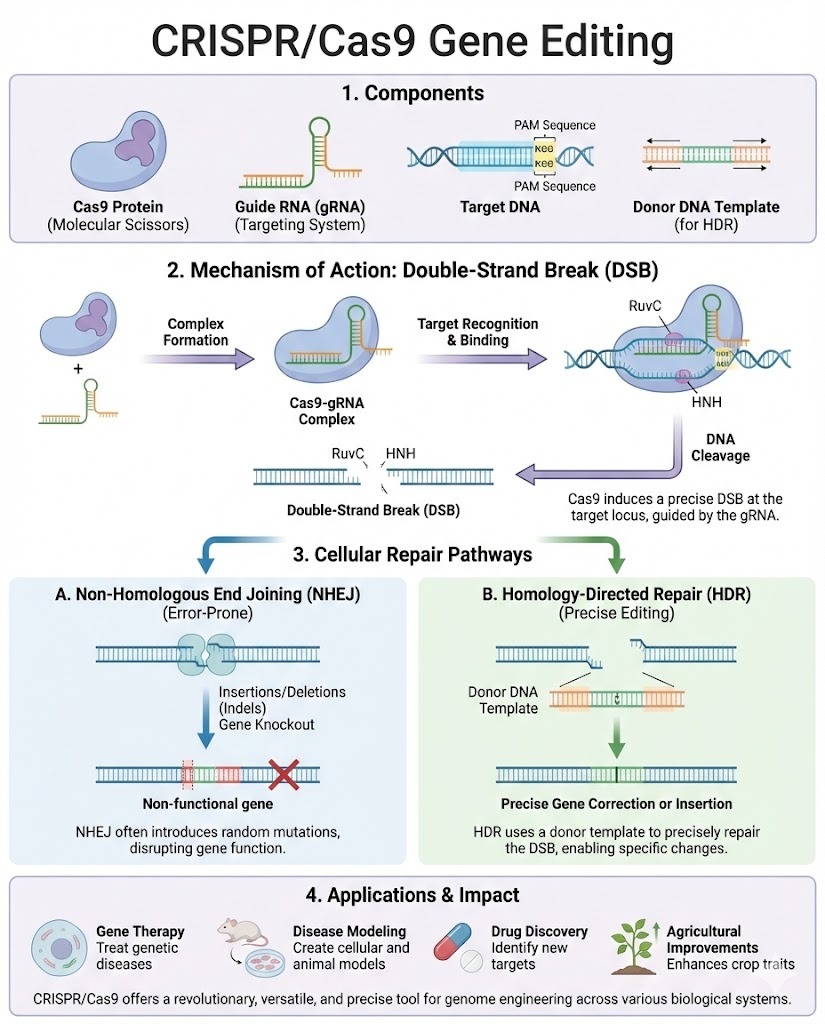
The CRISPR/Cas9 gene editing process relies on three main components:
-
A guide RNA that matches the target DNA sequence
-
The Cas9 enzyme that cuts the DNA
-
A repair mechanism within the cell that introduces the desired change
The guide RNA directs Cas9 to the exact spot in the genome. Once the cut is made, the cell attempts to repair the DNA. Scientists can exploit this natural repair process to:
-
Disable a gene
-
Insert a new gene
-
Correct a mutation
This simple yet powerful workflow is what makes CRISPR/Cas9 gene editing so widely adopted.
Key Advantages of CRISPR/Cas9 Gene Editing
Compared to earlier gene editing tools such as zinc finger nucleases or TALENs, CRISPR/Cas9 offers several major advantages.
-
High precision targeting
-
Faster development timelines
-
Lower cost
-
Ability to edit multiple genes at once
-
Broad compatibility across species
These benefits have accelerated research across many scientific disciplines.
Major Applications of CRISPR/Cas9 Gene Editing
Medical research and therapy
CRISPR/Cas9 gene editing is being explored for treating genetic disorders such as:
-
Sickle cell disease
-
Cystic fibrosis
-
Muscular dystrophy
-
Inherited blindness
-
Certain immune deficiencies
Clinical trials are already underway for some of these conditions, focusing on correcting defective genes directly within patient cells.
Cancer treatment
Researchers are using CRISPR/Cas9 gene editing to:
-
Engineer immune cells to attack tumors
-
Identify genes responsible for drug resistance
-
Discover new therapeutic targets
-
Study cancer development pathways
These approaches support the advancement of personalized oncology treatments.
Agriculture and food production
CRISPR/Cas9 gene editing is widely applied to improve crops by:
-
Increasing yield
-
Enhancing nutritional content
-
Improving drought tolerance
-
Reducing susceptibility to disease
-
Minimizing the need for chemical pesticides
Unlike traditional genetic modification, CRISPR edits can be made without introducing foreign DNA, which may simplify regulatory approval in some regions.
Industrial biotechnology
Microorganisms engineered with CRISPR/Cas9 are used to produce:
-
Biofuels
-
Pharmaceuticals
-
Industrial enzymes
-
Sustainable chemicals
This contributes to more efficient and environmentally friendly manufacturing processes.
Basic scientific research
CRISPR/Cas9 gene editing enables researchers to:
-
Study gene function
-
Model human diseases in animals
-
Analyze developmental biology
-
Investigate evolutionary mechanisms
Its accessibility has democratized genetic research across institutions worldwide.
Technical Limitations and Challenges
Despite its effectiveness, CRISPR/Cas9 gene editing is not without challenges.
Off-target effects
Occasionally, Cas9 may cut unintended DNA sites, potentially causing unwanted mutations. Improved guide RNA design and advanced variants of Cas9 are reducing this risk.
Delivery methods
Getting CRISPR components into target cells remains difficult, especially for tissues deep inside the body. Viral vectors, nanoparticles, and physical methods are being refined to improve delivery.
Mosaicism
When editing embryos or developing tissues, not all cells may be modified equally, leading to mixed genetic outcomes.
Regulatory complexity
Clinical applications require extensive testing to meet safety standards, which can slow adoption.
Ethical and Social Considerations
CRISPR/Cas9 gene editing raises important ethical questions, particularly regarding human germline editing.
Key concerns include:
-
Permanent genetic changes passed to future generations
-
Potential misuse for non-medical enhancements
-
Equity of access to advanced therapies
-
Long-term safety uncertainties
Most countries currently restrict or prohibit germline editing while allowing somatic cell therapies and laboratory research under strict regulation.
Public engagement, transparent governance, and international cooperation remain essential to guide responsible development.
The Future of CRISPR/Cas9 Gene Editing
The technology continues to evolve rapidly.
Emerging developments include:
-
Base editing that changes single DNA letters without cutting the strand
-
Prime editing for highly precise genetic corrections
-
Improved Cas enzymes with greater specificity
-
Integration with gene therapy platforms
-
Automation for large-scale genome screening
As these innovations mature, CRISPR/Cas9 gene editing is expected to become an increasingly central tool in medicine and biotechnology.
Healthcare may eventually shift from treating symptoms to correcting genetic causes at their source.
Choosing CRISPR Tools and Platforms
Organizations adopting CRISPR/Cas9 gene editing often evaluate:
-
Target organism
-
Required editing precision
-
Throughput needs
-
Regulatory environment
-
Intellectual property considerations
-
Laboratory infrastructure
Commercial platforms now offer standardized kits, software tools, and delivery systems to streamline implementation.
Conclusion
CRISPR/Cas9 gene editing represents one of the most significant breakthroughs in biological science of the 21st century. By enabling precise, efficient, and affordable modification of genetic material, it has opened new pathways in medicine, agriculture, and industrial biotechnology.
While technical and ethical challenges remain, continued innovation and responsible oversight are shaping a future where genetic diseases can be corrected, crops can be sustainably improved, and biological research can advance at unprecedented speed.
As the technology matures, CRISPR/Cas9 gene editing is likely to become a foundational component of precision medicine and global biotechnology development.
Frequently Asked Questions About CRISPR/Cas9 Gene Editing
What is CRISPR/Cas9 gene editing used for?
CRISPR/Cas9 gene editing is used to modify DNA in living cells for research, medical treatment, agriculture, and industrial biotechnology. It allows scientists to correct mutations, study gene function, and engineer organisms with specific traits.
How accurate is CRISPR/Cas9 gene editing?
The technology is highly precise, but not perfect. Advances in guide RNA design and enzyme engineering have greatly reduced off-target effects, making modern CRISPR systems increasingly reliable.
Is CRISPR/Cas9 gene editing safe for humans?
Somatic cell applications are being tested in clinical trials and have shown promising safety profiles. Germline editing remains controversial and is tightly restricted due to ethical and long-term safety concerns.
How is CRISPR/Cas9 different from traditional genetic modification?
Traditional genetic modification often inserts foreign genes randomly into the genome. CRISPR/Cas9 gene editing makes targeted changes at specific DNA locations, offering greater precision and control.