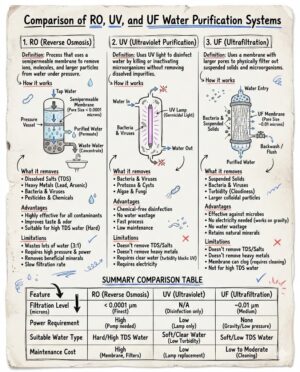
The journey to safe and clean drinking water often leads consumers through a maze of acronyms: RO, UV, and UF. These three technologies—Reverse Osmosis, Ultraviolet Disinfection, and Ultrafiltration—represent the most common and effective methods used in modern water purification. While all three aim to deliver potable water, their underlying mechanisms, purification capabilities, and suitability for different water sources vary significantly. Understanding these differences is crucial for any consumer or stakeholder looking to invest in a reliable water treatment system.
Reverse Osmosis (RO) is often regarded as the gold standard for comprehensive water purification, particularly when dealing with heavily contaminated or hard water sources. The fundamental principle of RO involves forcing water, under high pressure, through a semi-permeable membrane. This membrane boasts an extremely fine pore size, typically around 0.0001 microns, which is the smallest of the three technologies. This microscopic precision allows water molecules to pass through while effectively blocking nearly all larger contaminants.
What makes RO uniquely powerful is its ability to remove Total Dissolved Solids (TDS). TDS refers to the collective measure of all inorganic and organic substances dissolved in water, including salts, heavy metals like arsenic, lead, and fluoride, as well as calcium and magnesium ions that cause water hardness. An RO system can successfully remove up to 99% of these dissolved solids, reducing the TDS level in the output water to near-zero. This capability makes RO purifiers indispensable for homes utilizing borewell water or groundwater, which often present high TDS levels (typically above 300 ppm) and heavy metal contamination.
However, this comprehensive purification comes with operational trade-offs. Firstly, the process requires significant pressure to push water through the ultra-fine membrane, meaning RO systems must rely on electricity and a high-pressure pump to function. Secondly, the purification process generates a substantial amount of wastewater. As pure water is forced through the membrane, the rejected impurities are flushed away with the remaining water, leading to water wastage. Modern RO systems are improving this efficiency, with some smart models incorporating permeate pumps to reduce waste by up to 80%, but it remains a notable characteristic of the technology.
A further point of discussion concerning RO is its non-selectivity. Because the membrane filters down to the molecular level, it removes both harmful contaminants and beneficial essential minerals naturally present in the water. This demineralization can sometimes lower the pH of the output water, making it slightly acidic. To counter this, many advanced RO systems now include alkaline filters or TDS control systems that re-introduce necessary minerals post-filtration, balancing the water’s pH and enhancing its taste.
Ultraviolet (UV) purification, by contrast, operates on a completely different mechanism, focusing primarily on microbiological safety rather than physical filtration. UV is not a filtration method; it is a disinfection process. It employs a high-intensity UV-C light, typically at a wavelength of 254 nm, to expose the flowing water. This light penetrates the cell structure of pathogenic microorganisms—such as bacteria, viruses, and cysts—and attacks their DNA. By scrambling the DNA, the UV light effectively inactivates or sterilizes these microbes, rendering them incapable of reproduction and thus harmless. This ensures the water is biologically safe for consumption.
The advantages of UV technology are considerable. It is highly effective at eliminating 99.9% of bacteria and viruses without the use of any chemicals, making it a clean, chemical-free disinfection method. Furthermore, UV systems do not alter the physical or chemical properties of the water; they do not remove dissolved solids, salts, or minerals. This means the taste and natural composition of the water remain unchanged. Unlike RO, UV purification produces no wastewater and typically requires low maintenance compared to membrane-based systems. It also operates well under normal tap water pressure, although it does require electricity to power the UV lamp.
The main limitation of a standalone UV purifier is its inability to remove dissolved or suspended solids. Because it only disinfects the water, any chemical contaminants (like pesticides or heavy metals) or physical impurities (like dust, sand, or rust) remain in the water. For this reason, UV purifiers are best suited for areas with municipal water supply that already has a low TDS level (typically below 200 ppm) but where microbial contamination is a concern, often serving as an extra layer of protection after primary water treatment. UV purification requires clear water to function effectively, as turbidity can shield microorganisms from the UV light, reducing its efficacy.
Ultrafiltration (UF) represents a middle ground, functioning as a physical barrier but with a larger pore size than RO. The core component of a UF purifier is a hollow fiber membrane with a pore size generally around 0.01 microns. While significantly larger than the RO membrane’s pores, this size is still fine enough to physically trap and remove larger impurities such as suspended solids, colloids, bacteria, cysts, and larger viruses. Since UF is a physical filtration process, it removes these particles from the water stream, unlike UV, which only inactivates them. UF purifiers, therefore, are excellent for filtering out visible impurities and larger microbial threats.
One of the most appealing features of UF technology is its operational simplicity and robustness. UF purifiers do not require electricity to operate, as they can function effectively using just the normal pressure of tap water. They also do not produce any wastewater and retain the natural minerals in the water, similar to UV technology. These characteristics make UF purifiers ideal for regions prone to frequent power cuts or for consumers who prioritize retaining essential minerals and seek a low-cost, low-maintenance solution. UF membranes are also known for being quite long-lasting, often working for many years before requiring replacement.
However, UF shares a significant limitation with UV: it cannot remove Total Dissolved Solids (TDS). The 0.01-micron pores are too large to block small, soluble molecules, including dissolved salts, heavy metal ions, and many specific organic contaminants and chemicals. Therefore, UF purifiers are recommended only for source water that already has a low TDS level. If the water source is borewell water or is suspected to contain heavy metals or high hardness, a standalone UF system is insufficient for complete purification.
To summarize the comparison, the choice between these technologies is fundamentally a decision based on the source water quality, specifically its TDS level and the type of contaminants present. The decision matrix is guided by the contaminants that each technology effectively targets: RO for molecular contaminants, UF for particulate and large microbial contaminants, and UV for microbial inactivation.
If your water has a high TDS level (above 300 ppm), comes from a borewell or groundwater source, or is known to contain heavy metals or chemicals like arsenic and fluoride, then Reverse Osmosis (RO) is the clear and necessary choice. It provides the highest level of purity by targeting and removing dissolved solids, offering molecular separation. It is designed to handle hard, brackish, or salty water sources.
If your water source is municipal tap water with a low TDS level (below 200 ppm) and is clear of suspended solids, but you are primarily concerned about biological contamination (bacteria and viruses), the Ultraviolet (UV) purifier is an excellent option for chemical-free disinfection. It works best on already relatively clean water and is often the preferred choice for city tap water.
If your municipal water has low TDS, but contains some visible suspended particles or risk of bacterial contamination, and you require a non-electric, low-maintenance system that retains minerals, then Ultrafiltration (UF) is suitable. It acts as a robust physical filter for larger microbes and particles without needing power.
The modern market, recognizing that source water often presents multiple challenges, has increasingly shifted towards hybrid systems. These advanced purifiers combine the strengths of all three technologies—often RO, UV, and UF—into a single unit. In a typical RO + UV + UF combination system, water first passes through pre-filters (like sediment and carbon), then the RO membrane for TDS and dissolved solids removal. The final stages often include UV for disinfection and UF for polishing or secondary microbial defense, ensuring comprehensive protection. This integrated approach offers the gold standard for purity and protection, addressing high TDS, heavy metal contamination, suspended solids, and microbial threats simultaneously, making it suitable for water sources of unknown or varying quality.
Furthermore, the physical staging of filters in a multi-technology system is critical for efficiency and longevity. For instance, UF is often utilized as a pre-treatment step before the RO membrane. This is done because the UF membrane can effectively remove larger suspended particles and colloids that could otherwise clog the much finer RO membrane, thereby significantly extending the life and efficiency of the expensive RO component and reducing filter replacement frequency. In highly regulated or specialized industrial applications, UF might also be placed at the end to ensure maximum microbial removal credits.
In terms of operational feasibility and environmental impact, UV and UF shine in environments where electricity is unreliable or water conservation is critical. UV requires electricity for the lamp but operates with normal water pressure and minimal waste. UF requires neither electricity nor produces waste, relying purely on physical filtration. RO, while providing unparalleled purification, demands consistent electricity to maintain high pressure and must manage the output of rejected water, which is an important consideration for water conservation efforts.
Safety and regulation are also key factors differentiating these technologies. The purification provided by RO and UF is a physical barrier that removes contaminants, while UV provides inactivation. Regardless of the technology, regulatory compliance is paramount. For instance, in the U.S., the ANSI/NSF 60 standard governs acceptable impurity levels in treatment chemicals to ensure that the process of purification itself does not introduce new health risks, such as heavy metals, into the finished drinking water. Plant operators must confirm all components adhere to these rigorous health effect standards.
When selecting a system, consumers must first test their water’s TDS level and identify the specific contaminants of concern. Using a TDS meter is the most direct way to assess the need for RO technology. Choosing an RO purifier when UV or UF would suffice leads to unnecessary mineral removal and water wastage. Conversely, relying on UV or UF when the water has high TDS or heavy metals leaves dangerous dissolved contaminants untreated. The right water purifier is not necessarily the most technologically advanced, but the one that aligns precisely with the source water’s characteristics and the user’s requirements, often determined through careful water quality testing.
The continual advancement of water treatment technologies means that formulations are not static. Latest trends emphasize reduction of total cost performance, minimized environmental influence, and contribution to water and energy conservation. This ongoing development ensures that new materials and methods, like membrane technology integration in industrial settings (e.g., Ultrafiltration as pre-treatment for Reverse Osmosis in industrial applications), are constantly being refined. The chemical and physical principles governing RO, UV, and UF selection remain the backbone for operational excellence in this rapidly evolving environmental and regulatory landscape.
The future of this industry emphasizes increased efficiency and integration. Innovations like smarter RO systems that significantly reduce water wastage and the shift toward mercury-free, energy-efficient LED UV technology are continually refining the options available. However, the fundamental comparison remains: RO for dissolved solids and comprehensive molecular removal, UV for chemical-free microbial disinfection of clear water, and UF for non-electric, mineral-retaining physical removal of suspended particles and microbes in low-TDS water. Making an informed decision based on these core distinctions ensures the chosen purification system consistently delivers safe, clean, and high-quality finished drinking water.
Ultimately, whether for a small home or a large commercial operation, these three technologies—RO, UV, and UF—provide the pillars of modern water purification. While they can function independently, their greatest potential is often realized when utilized synergistically, offering a multilayered defense against the diverse spectrum of impurities found in source water today. This synthesized approach ensures maximum purity and protection, aligning water quality goals with operational efficiency and sustainability.
For individuals dealing with variable or unknown water sources, choosing a comprehensive combination purifier that employs all three methods is often the safest and most prudent investment, minimizing the risk of exposure to a wide range of contaminants, from dissolved salts and heavy metals to bacteria, viruses, and physical particulate matter.