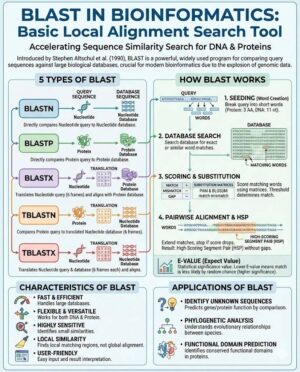
BLAST, which stands for Basic Local Alignment Search Tool, is universally recognized as the foundational algorithm of modern bioinformatics. Since its introduction in 1990 by Stephen Altschul, Warren Gish, Webb Miller, Eugene Myers, and David J. Lipman, BLAST has fundamentally transformed molecular biology research by providing a computationally tractable solution to the problem of searching newly determined nucleotide or protein sequences against exponentially growing public databases.
Before BLAST, sequence comparison relied primarily on global and local dynamic programming methods, notably the Needleman-Wunsch and Smith-Waterman algorithms, respectively. While Smith-Waterman guarantees the identification of the statistically optimal local alignment, its quadratic time complexity made it too slow for routine, large-scale database queries involving sequences numbering in the tens of millions.
BLAST solved this efficiency challenge by adopting a heuristic approach. It sacrifices the guarantee of finding the absolute best possible alignment for immense speed and efficiency. The core principle of BLAST is that any biologically significant alignment, regardless of its total length or score, must contain at least one high-scoring segment pair (HSP) that is found without gaps.
The algorithm’s procedure is broken down into three primary stages: seeding, extension, and evaluation.
The process begins with the query sequence being broken down into short, overlapping fragments known as “words.” For protein queries, the typical word size is three amino acids (W=3), while for nucleotide queries, it is usually eleven bases (W=11).
Next, the algorithm generates a list of words that score above a specific threshold (T) when compared to the query word. This scoring is performed using appropriate substitution matrices, such as BLOSUM62 for proteins or a nucleotide identity matrix for DNA. This list contains not just exact matches, but also similar words that may reflect evolutionary substitutions.
These high-scoring words are then used as seeds to initiate searches within the target database. The database is indexed for these words, allowing for extremely rapid location of potential match regions. This initial search phase efficiently filters out the vast majority of sequences that are unlikely to yield significant alignments, which is the key to BLAST’s speed.
The second stage, extension, commences once a high-scoring seed word is found. The alignment is extended both upstream and downstream from the seed word, without initially allowing for gaps, as long as the cumulative alignment score remains above a defined cutoff. This step identifies the high-scoring segment pairs (HSPs).
Once the initial gapless extension identifies a potential match region, the third stage begins: statistical evaluation. The alignment’s quality is quantified using a Bit Score (a normalized measure independent of the scoring matrix) and, crucially, the Expectation value (E-value).
The E-value represents the expected number of alignments with a score equal to or better than the observed score that would occur purely by chance in a database of the current size. A low E-value (e.g., 1e-6) provides strong statistical evidence that the observed similarity is biologically meaningful, indicating homology rather than random chance.
The versatility of BLAST is reflected in its family of programs, each tailored to different combinations of query and database sequence types.
BLASTN is designed for comparing a nucleotide query sequence against a nucleotide sequence database. It is often used for tasks such as confirming primer specificity or finding genomic location.
BLASTP compares a protein query sequence against a protein sequence database. Protein comparison is more sensitive for detecting distant evolutionary relationships because protein sequences evolve more slowly and the use of substitution matrices captures conservative amino acid changes.
BLASTX takes a nucleotide query, translates it in all six possible reading frames, and compares the resulting six protein sequences against a protein database. This is essential for characterizing novel cDNA or genomic sequences where the coding frame is not yet established.
TBLASTN takes a protein query sequence and searches it against a nucleotide database that is dynamically translated into all six reading frames. TBLASTN is incredibly useful for finding potential protein-coding regions in raw genomic DNA, even across species or when searching highly diverged homologs.
TBLASTX compares the six-frame translations of a nucleotide query sequence against the six-frame translations of a nucleotide database. While the most sensitive for detecting remote homology between two nucleic acid sequences, it is the most computationally expensive and thus used less frequently in routine analysis.
Beyond the core family, PSI-BLAST (Position-Specific Iterated BLAST) extends sensitivity through iteration. It first generates high-scoring hits, then constructs a Position-Specific Scoring Matrix (PSSM) from these hits, which captures the conserved and variable residues in the aligned family. This PSSM is then used to search the database again, allowing the detection of highly diverged members that a single search might miss.
The biological impact of BLAST cannot be overstated. It is the first line of investigation for virtually every novel sequence discovered. For example, if a researcher sequences a new protein, performing a BLASTP search is necessary to assign putative function based on homologous proteins with known functions. This process, known as annotation, drives much of the functional genomics field.
In diagnostics, BLAST is used to quickly identify pathogens by comparing their genomic sequences against microbial and viral databases. In evolutionary biology, it underpins phylogenetic analysis by identifying orthologs and paralogs—genes derived from speciation and duplication events, respectively—across different organisms.
The practical operational considerations of using BLAST involve careful selection of parameters. The E-value cutoff is critical; setting it too high may yield spurious, random matches, while setting it too low may exclude genuine, but highly divergent, homologous sequences.
Substitution matrices also govern the sensitivity. BLOSUM matrices are derived empirically from aligned blocks of sequences and are generally preferred for finding closer relatives, with BLOSUM62 being the standard choice. PAM matrices, based on observed evolutionary mutation rates, are sometimes used for tracing more ancient evolutionary events.
To prevent statistical anomalies caused by low-complexity regions (e.g., stretches of simple sequence repeats like AAAAAA or GGGGGG), BLAST employs compositional adjustment and filtering mechanisms. These filters (DUST for DNA, SEG for protein) mask these regions so they do not artificially inflate alignment scores and reduce the significance of true biological hits.
While dynamic programming methods are guaranteed to find the mathematically optimal alignment, BLAST’s heuristic nature introduces the possibility of missing short, significant local alignments, especially if they do not contain an initial word hit that passes the high-scoring threshold (T). However, for practical purposes involving large databases, the speed advantage overwhelmingly outweighs this minor risk.
The continuous growth of biological data mandates that BLAST remains a living technology. Modern iterations incorporate advanced statistical models and database indexing strategies to handle petabyte-scale datasets. Furthermore, the integration of BLAST functionality into cloud computing environments has enhanced its parallel processing capabilities, allowing researchers to run complex analyses across massive, custom databases efficiently.
In summary, BLAST is not merely a tool; it is an indispensable methodology. It transforms the overwhelming complexity of sequence data into meaningful biological information, enabling the rapid inference of function, evolutionary history, and structural characteristics, thereby accelerating discovery across all disciplines of the life sciences. Its clever heuristic design and robust statistical foundation ensure its continued status as the backbone of comparative sequence analysis in the genomic era.
The choice between nucleotide and protein searching is a fundamental decision guided by the principle of evolutionary conservation. Since the genetic code is degenerate (multiple codons can code for the same amino acid), many mutations at the DNA level are “silent,” meaning they do not change the resulting protein. Therefore, protein sequences retain functional and evolutionary signals longer than their corresponding nucleotide sequences, making BLASTP and TBLASTN generally more effective for identifying distantly related sequences compared to BLASTN.
Another area where BLAST is critical is identifying potential gene products in newly sequenced genomes. Genomic data often contains many non-coding regions and pseudogenes. By using BLASTX to compare the translated sequence against known protein catalogs, researchers can quickly delineate functional open reading frames (ORFs) from background noise.
The graphical output provided by NCBI’s BLAST web interface is essential for interpretation. Alignments are color-coded based on their scores, providing an intuitive visual map of sequence similarity, which is crucial when dealing with hundreds or thousands of hits. This visualization allows users to quickly assess query coverage and identify domain architecture based on where significant hits cluster.
The underlying mathematics that allow the E-value calculation to be so reliable stem from extreme value distribution theory. This theory dictates how likely the highest score is to occur by chance in a search of a specific length and composition, giving the user a robust measure of confidence in their results, regardless of how large the database is at that moment.
The implementation of gap penalties is another nuance crucial to biologically accurate results. Gaps represent insertions or deletions (indels) that occur during evolution. The cost assigned to opening a gap is typically much higher than the cost assigned to extending an existing gap, reflecting the biological reality that a single mutational event often causes a large deletion or insertion, rather than many small, sequential ones.
The development of specialized sequence databases also relies heavily on BLAST. For instance, the creation of protein domain databases like Pfam and structural classification databases often starts with large-scale BLAST comparisons to identify initial families and homologous regions that can then be subjected to more detailed multiple sequence alignment and profile building.
The concept of filtering low-complexity sequences is a necessary compromise. While filtering speeds up the search and reduces noise, it can occasionally mask short, biologically relevant motifs that happen to reside within a low-complexity region. Experienced users must sometimes disable filtering for specific queries when seeking such challenging targets, accepting the potential for increased false positives.
Furthermore, in the context of personalized medicine and genomics, rapid sequence comparison is vital. When sequencing a patient’s exome or genome, the first step is often to align the sequence reads to a reference genome, followed by using BLAST to confirm specific variants or insertions against curated SNP (Single Nucleotide Polymorphism) databases. This ensures the accuracy of variant calling prior to clinical interpretation.
The continued refinement of the BLAST algorithm, including the introduction of tools like DELTA-BLAST, which leverages pre-computed conserved domain databases (CDD) to initialize its search, continually pushes the boundaries of sensitivity without sacrificing the necessary speed. DELTA-BLAST uses domain models as context, significantly improving the PSSM construction and allowing for the detection of extremely distant relationships.
In essence, mastering BLAST involves more than just running the program; it requires a deep understanding of its statistical underpinnings, the implications of word size and scoring matrix selection, and the utility of its specialized variations. This knowledge enables researchers to translate raw genomic data into testable hypotheses about function, structure, and evolution, cementing BLAST’s role as the single most important computational instrument in the biologist’s toolkit.
The influence of BLAST extends into regulatory and quality control applications, particularly in biotechnology and agriculture, where accurate sequence verification is mandatory for product approval and safety testing. Its reliability and widespread acceptance make it the default tool for comparing proprietary sequences against public records to check for contamination or unauthorized use.
Finally, the open-source availability and continual maintenance of the BLAST code base by organizations like the NCBI ensure that it remains accessible and adaptable, fostering further innovation in sequence analysis methodologies globally.