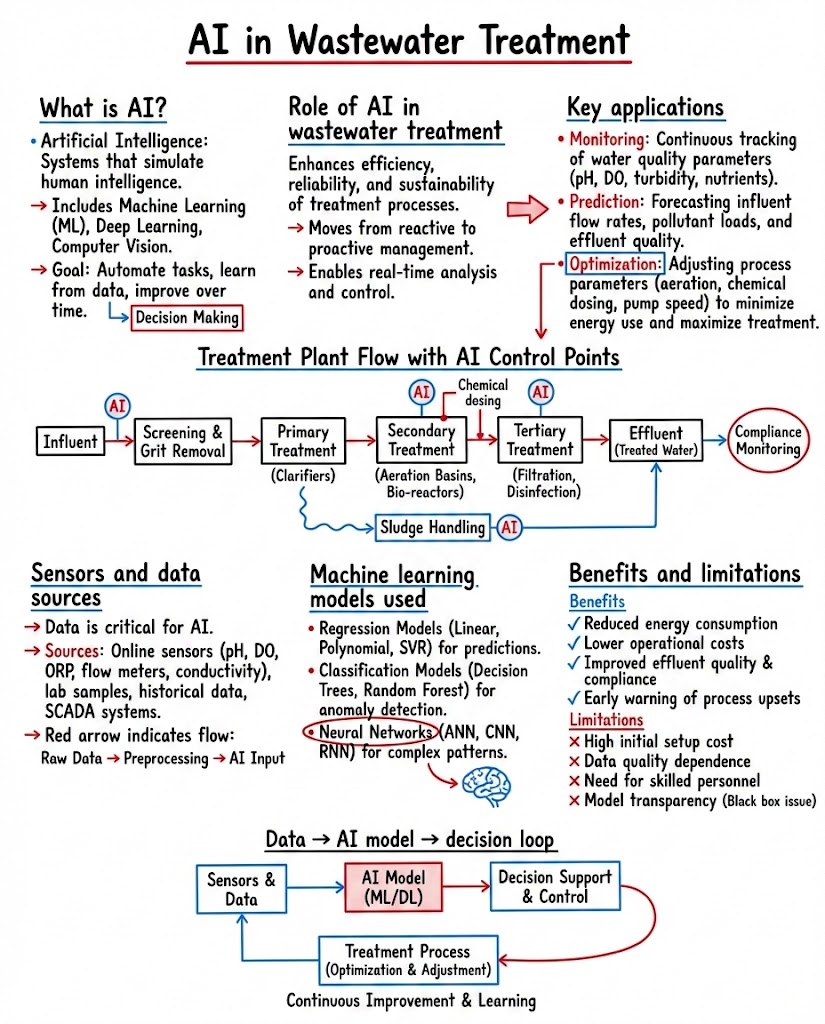
Artificial Intelligence (AI) is revolutionizing wastewater treatment, transforming traditional plants from reactive, rule-based systems into smart, predictive, and highly efficient operations. As global water stress intensifies—driven by population growth, industrialization, urbanization, and climate change—wastewater treatment plants (WWTPs) face mounting pressure to produce higher-quality effluent, remove emerging contaminants, reduce energy consumption, and adapt to variable influent conditions. AI, especially machine learning (ML) and deep learning, offers powerful solutions by extracting insights from vast sensor data, optimizing processes in real time, and forecasting outcomes that were previously difficult to predict.
Why AI Fits Wastewater Treatment So Well
Wastewater treatment involves complex, nonlinear biological, chemical, and physical processes. Activated sludge systems, for example, depend on delicate balances of dissolved oxygen (DO), nutrient levels, microbial communities, hydraulic loading, and temperature. Traditional control relies on manual adjustments or fixed setpoints, often leading to suboptimal performance, high energy use (aeration alone can consume 40–60% of a plant’s electricity), or occasional effluent quality violations.
AI excels here because:
- WWTPs generate enormous real-time data from sensors (flow, pH, turbidity, COD, ammonia, nitrate, phosphorus, DO, etc.).
- Processes exhibit time lags, feedback loops, and sensitivity to disturbances (storm events, industrial spikes).
- Optimization goals are multi-objective (effluent quality + energy + sludge production + chemical use).
Recent reviews (2024–2025) show explosive growth in publications on this topic, with bibliometric analyses highlighting neural networks, ensemble methods (XGBoost, Random Forest), deep learning (LSTM, GRU), and hybrid AI approaches as dominant techniques.
Key Applications of AI in Wastewater Treatment
1. Effluent Quality Prediction
AI models predict key effluent parameters (COD, BOD, TSS, TN, TP, NH₄-N) hours to days ahead using influent data, weather forecasts, and historical patterns.
- Models like XGBoost, Random Forest, LSTM, and GRU routinely achieve R² > 0.90–0.98 for COD, nutrients, and total suspended solids.
- Early warning of quality violations allows proactive adjustments (e.g., increasing sludge recycling or chemical dosing).
2. Process Optimization and Real-Time Control
AI replaces static setpoints with dynamic, data-driven decisions.
- Aeration control: Deep reinforcement learning or model predictive control (MPC) integrated with neural networks minimizes blower energy while maintaining DO targets.
- Chemical dosing optimization (coagulants, polymers) reduces consumption by 15–30%.
- Energy forecasting and smart load shifting help WWTPs become more grid-responsive or even energy-positive via biogas optimization.
Recent studies report 10–25% energy savings in full-scale plants using AI-driven control.
3. Anomaly Detection and Fault Diagnosis
AI identifies sensor drift, equipment failures (pumps, blowers), unusual influent events, or process upsets (bulking sludge, toxicity) before they cause major issues.
- Techniques include autoencoders, isolation forests, and clustering combined with explainable AI (SHAP values) to interpret why an anomaly occurred.
4. Removal of Emerging Contaminants
Machine learning predicts removal efficiency of pharmaceuticals, personal care products (PPCPs), PFAS, and microplastics across different treatment trains (activated carbon, ozonation, membranes, algae-based systems).
- Models use molecular descriptors + operational parameters to classify high/low removal compounds.
5. Resilience to Climate Extremes
Heavy rainfall, prolonged droughts, and temperature swings challenge WWTP stability. AI models integrate weather data and inflow forecasting to adapt operations (e.g., bypassing during extreme wet weather, rerouting flows, or adjusting SRT).
Recent 2025 papers specifically address AI for climate-adaptive wastewater management.
Real-World Examples and Maturity
Several utilities already deploy AI:
- Self-learning systems analyze patterns and automatically tune dissolved oxygen, return activated sludge rates, and waste sludge schedules.
- Full-scale implementations in Europe and North America report 15–35% reductions in energy and chemicals, with payback periods of 1–3 years.
- Digital twins of WWTPs (AI + mechanistic models) allow scenario testing without risking real operations.
Challenges and Limitations
Despite the promise, barriers remain:
- Data quality — Missing values, sensor fouling, and inconsistent labeling hinder model performance.
- Interpretability — Black-box deep learning models face resistance from regulators and operators who need to understand why a control action is suggested.
- Transferability — Models trained on one plant often underperform at another due to site-specific biology and influent composition.
- Implementation costs — Sensor upgrades, data infrastructure, and staff training require investment.
- Cybersecurity — Increased connectivity introduces risks.
Explainable AI (XAI), federated learning (to share knowledge across plants without sharing raw data), and hybrid physics-informed ML are active research areas addressing these issues.
Future Outlook
Looking toward 2030, AI in wastewater treatment is expected to evolve toward:
- Fully autonomous WWTPs with AI agents managing most routine decisions.
- Integration with IoT, 5G, and edge computing for ultra-low latency control.
- AI supporting resource recovery (nutrients, water reuse, energy) and circular economy goals.
- Standardized benchmarks and open datasets to accelerate progress and model sharing.
In summary, AI is no longer a futuristic concept in wastewater treatment—it is a practical, rapidly maturing tool delivering measurable improvements in effluent quality, energy efficiency, operational resilience, and cost. As sensor costs continue to fall and computing power grows, AI will become as fundamental to modern WWTPs as activated sludge itself.
The transition to smarter water infrastructure is underway, and the plants that embrace AI earliest stand to gain the greatest advantage in an era of increasing water scarcity and regulatory pressure.