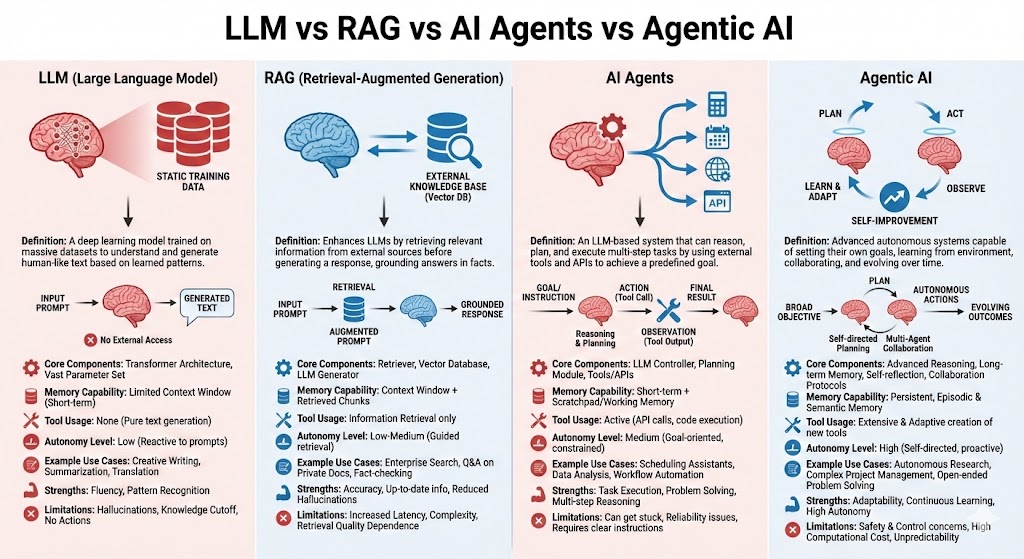
If you’ve been anywhere near Silicon Valley lately — or just scrolling Twitter while your actual work piles up — you’ve probably heard a bunch of tech nerds throwing around terms like “LLMs,” “RAG,” “AI agents,” and “agentic AI” like they’re discussing the Yankees lineup.
Spoiler alert: They’re not all the same thing. And no, you’re not dumb for being confused.
Here’s the no-BS breakdown of what these buzzy AI terms actually mean — and why venture capitalists are tripping over themselves to throw money at anything with “agentic” in the pitch deck.
LLMs: The Big Brain That Started It All
Large Language Models — ChatGPT, Claude, that thing your nephew uses to write his college essays — are basically the foundation of this whole AI circus.
Think of an LLM as that one friend who read the entire internet and now has an opinion about everything. It’s been trained on billions of words and can spit out human-sounding text faster than you can say “is this going to take my job?”
The catch? LLMs are stuck in time. ChatGPT doesn’t know the Knicks’ score from last night unless someone updated it. It’s working off whatever it learned during training — which could be months or years old. Like your uncle still quoting 2016 election polls at Thanksgiving.
RAG: When the AI Actually Googles It
Retrieval-Augmented Generation — mercifully shortened to RAG — is what happens when someone finally gave the AI access to current information.
Instead of just regurgitating what it learned in AI kindergarten, RAG systems can pull up relevant documents, search databases, or check actual sources before answering. It’s like the difference between a student BSing an essay from memory versus one who actually cracked open the textbook.
Companies love RAG because it means their AI chatbot can answer questions about their specific products or policies without hallucinating random nonsense. Your AI helper actually reads the employee handbook instead of making up PTO policies that would make Sweden jealous.
AI Agents: The Ones That Actually DO Stuff
Here’s where it gets spicy.
AI agents don’t just chat — they take action. Book that flight. Send that email. Order your groceries. Cancel your gym membership that you haven’t used since February.
Think of agents as the difference between asking someone for directions versus having them drive you there. One gives you information; the other handles the whole damn thing.
The really wild ones can use multiple tools, make decisions on the fly, and complete complex tasks that would normally require you to click through seventeen different websites while losing your mind.
“It’s the difference between talking to a very smart parrot and hiring an actual assistant,” said one AI researcher who asked not to be named because his company’s PR team has enough headaches.
Agentic AI: The Buzzword That Ate Silicon Valley
And now we arrive at “agentic AI” — the term that’s currently making VCs salivate and your IT department nervous.
Agentic AI is basically AI agents on steroids. We’re talking systems that can set their own goals, plan complex strategies, adapt when things go sideways, and work on tasks over days or weeks without constant hand-holding.
It’s autonomous, it’s proactive, and it’s got tech executives either giddy with excitement or quietly updating their résumés.
The difference between a regular AI agent and agentic AI? Regular agents follow your instructions like a well-trained dog. Agentic AI is more like… well, an actual agent. It figures out how to achieve what you want, pivots when needed, and doesn’t need you micromanaging every step.
So What’s the Actual Difference?
Here’s the cheat sheet:
LLM: Talks real good. Knows a lot. Stuck in the past.
RAG: LLM that can look stuff up. Finally knows what day it is.
AI Agent: Actually does tasks for you. Books the reservation, doesn’t just recommend restaurants.
Agentic AI: The agent that doesn’t need you breathing down its neck. Plans its own route, adjusts on the fly, gets stuff done without sixteen follow-up emails.
Why Should You Care?
Because this tech is already creeping into everything from customer service to legal research to that app your boss just made mandatory.
The progression from LLMs to agentic AI represents a fundamental shift from “cool party trick” to “this might actually change how work works.” We’re moving from AI that impresses you in a demo to AI that handles your Tuesday afternoon while you’re stuck in traffic.
And yeah, that does raise some questions. Like what happens when your AI assistant decides the best way to clear your calendar is to email your boss that you quit. Or when agentic AI optimizes your company’s budget by eliminating positions that start with “Junior.”
But for now, the main thing to know is this: When someone breathlessly tells you about their startup’s “agentic AI solution powered by RAG-enhanced LLMs,” they’re basically saying they built a smart chatbot that can Google stuff and maybe book you an Uber.
Which, to be fair, is still pretty cool.
Just maybe not “destroy-all-jobs-by-Tuesday” cool.
Yet.