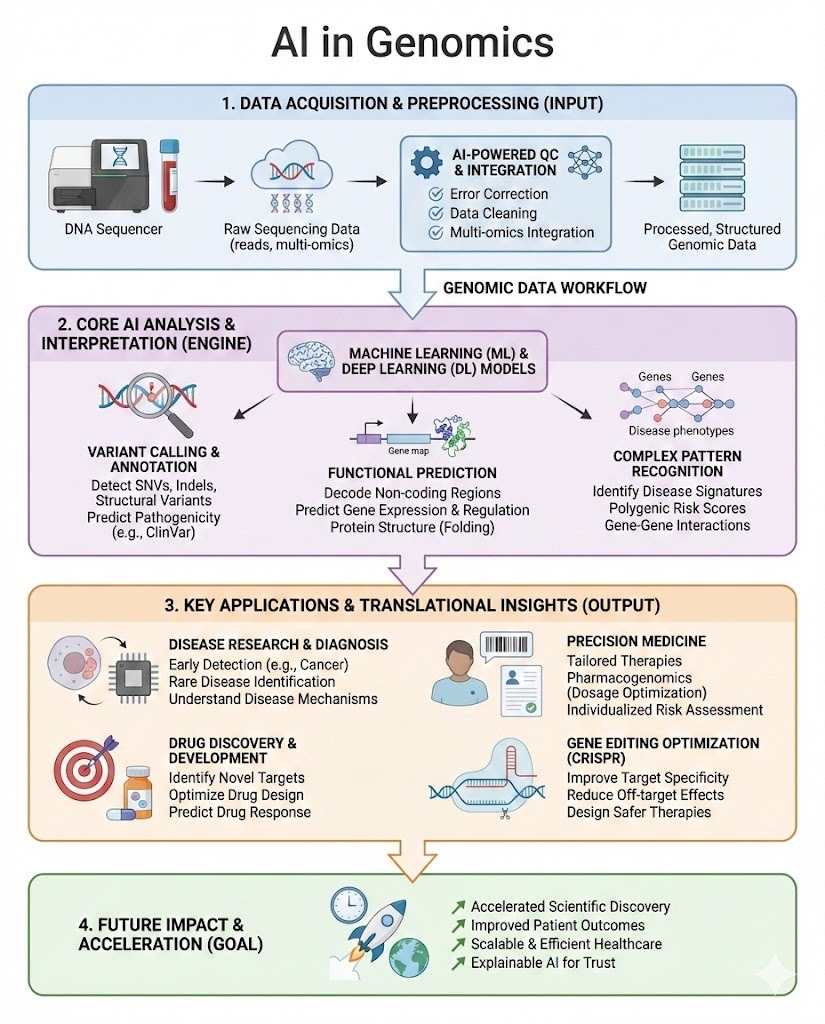
The convergence of advanced computing and genetic science is reshaping how researchers understand biology, diagnose disease, and develop treatments. AI in Genomics has become one of the most influential forces behind this shift, enabling faster data analysis, more accurate predictions, and discoveries that were previously out of reach.
Genomic data is vast, complex, and continuously expanding. A single human genome contains over three billion base pairs, and modern sequencing technologies generate massive datasets in a matter of hours. Traditional analytical methods struggle to keep pace. Intelligent algorithms, however, are designed to detect patterns, interpret subtle variations, and process information at a scale that matches modern research needs.
This article explores how AI in Genomics works, its key applications, benefits, challenges, and what the future may hold for this rapidly evolving field.
Why Genomics Needs Advanced Data Intelligence
Genomics focuses on studying DNA, genes, and their interactions. The goal is to understand how genetic variations influence health, disease, and biological traits. While sequencing technology has become faster and more affordable, data interpretation remains a major bottleneck.
Several challenges drive the need for advanced computational approaches:
-
Extremely large datasets from sequencing projects
-
Complex relationships between genes, environment, and disease
-
Time sensitive clinical decision making
-
High costs associated with manual data processing
-
Increasing demand for personalized medicine
AI in Genomics addresses these challenges by automating analysis, identifying meaningful patterns, and supporting researchers and clinicians with actionable insights.
Core Applications of AI in Genomics
The integration of intelligent systems into genomic workflows has unlocked a wide range of practical uses across research and healthcare.
Variant detection and interpretation
One of the most common uses is identifying genetic variants that may contribute to disease. Algorithms can rapidly scan genomes to locate mutations and assess their potential impact.
Benefits include:
-
Faster detection of rare variants
-
Improved accuracy in distinguishing harmful mutations from benign ones
-
Reduced false positives in sequencing results
This capability is especially valuable for diagnosing inherited disorders and rare diseases.
Drug discovery and development
Pharmaceutical companies increasingly rely on AI in Genomics to accelerate drug research. By analyzing genetic data, models can predict how specific genes influence disease pathways and how patients may respond to certain therapies.
Key advantages:
-
Identification of new drug targets
-
Shorter development timelines
-
Better prediction of side effects
-
Optimization of clinical trial design
These improvements help reduce costs while increasing the likelihood of successful treatments.
Precision medicine
Precision medicine aims to tailor healthcare based on individual genetic profiles. AI systems analyze genomic data alongside clinical records to recommend targeted therapies and preventive strategies.
Examples include:
-
Selecting cancer treatments based on tumor genetics
-
Predicting patient response to medications
-
Identifying individuals at high risk for chronic diseases
This approach improves treatment outcomes and minimizes unnecessary interventions.
Population genomics and epidemiology
Large scale studies of genetic variation across populations provide insights into disease prevalence and susceptibility. AI in Genomics helps process millions of genetic records to uncover trends and correlations that guide public health strategies.
Applications include tracking genetic risk factors for infectious diseases and understanding how genetics influence responses to vaccines.
Functional genomics
Understanding what genes actually do is just as important as identifying them. Intelligent systems help predict gene function, regulatory relationships, and protein interactions, accelerating fundamental biological research.
Benefits of AI in Genomics
The growing adoption of these technologies is driven by several clear advantages.
Speed and scalability
Tasks that once took weeks or months can now be completed in hours. This rapid processing enables researchers to explore more hypotheses and clinicians to make quicker decisions.
Improved accuracy
Advanced pattern recognition reduces human error and enhances the reliability of variant classification, disease prediction, and treatment selection.
Cost efficiency
Automation lowers labor costs and reduces the need for repetitive manual analysis, making genomic services more accessible.
Discovery of hidden patterns
Intelligent systems can uncover subtle relationships between genes and diseases that may not be obvious to human analysts, leading to new scientific insights.
Support for personalized healthcare
By integrating genomic data into clinical workflows, healthcare providers can offer more individualized and effective care.
Challenges and Limitations
Despite its promise, AI in Genomics is not without obstacles.
Data quality and bias
Models are only as good as the data they are trained on. Incomplete or biased datasets can lead to inaccurate predictions and unequal healthcare outcomes across different populations.
Privacy and security concerns
Genetic data is highly sensitive. Ensuring secure storage, ethical use, and regulatory compliance remains a major priority.
Interpretability
Some algorithms function as complex black boxes, making it difficult to explain how certain conclusions are reached. This can limit trust and adoption in clinical settings.
Integration with existing systems
Healthcare infrastructure often relies on legacy software, making seamless integration challenging and costly.
Regulatory approval
Clinical applications must meet strict regulatory standards, which can slow down deployment even when the technology is ready.
The Future of AI in Genomics
The next decade is expected to bring even deeper integration between intelligent systems and genetic science.
Emerging trends include:
-
Real time genomic analysis during clinical visits
-
Integration of multi omics data such as proteomics and metabolomics
-
Improved explainability for clinical decision support tools
-
Wider adoption in developing healthcare systems
-
Collaborative global genomic databases for research and public health
As these technologies mature, they will likely become standard tools in both laboratories and hospitals.
AI in Genomics is not simply an enhancement to existing methods. It represents a fundamental shift in how genetic information is processed, understood, and applied.
Conclusion
AI in Genomics is transforming the landscape of genetic research and modern medicine. By enabling faster analysis, higher accuracy, and deeper insights, it helps researchers uncover the genetic foundations of disease and supports clinicians in delivering more personalized care.
From variant detection and drug discovery to population health studies and precision medicine, the applications continue to expand. While challenges such as data privacy, bias, and regulatory complexity remain, ongoing advancements are steadily addressing these issues.
As genomic data grows in volume and importance, intelligent computational approaches will play an increasingly central role in turning raw sequences into meaningful medical knowledge.
Frequently Asked Questions
What is AI in Genomics used for?
AI in Genomics is used to analyze large genetic datasets, identify disease related variants, support drug discovery, improve diagnostic accuracy, and enable personalized treatment strategies based on individual DNA profiles.
How does AI improve genomic research?
It accelerates data processing, detects complex patterns in genetic information, reduces manual errors, and allows researchers to study genetic relationships at a scale that traditional methods cannot handle efficiently.
Is AI in Genomics safe for patient data?
When properly implemented, it follows strict data protection standards, encryption practices, and regulatory guidelines. However, continuous attention to privacy, consent, and cybersecurity is essential to maintain patient trust.
Will AI replace genetic researchers?
No. These systems are designed to assist experts, not replace them. Human oversight remains critical for interpreting results, making clinical decisions, and guiding ethical research practices.