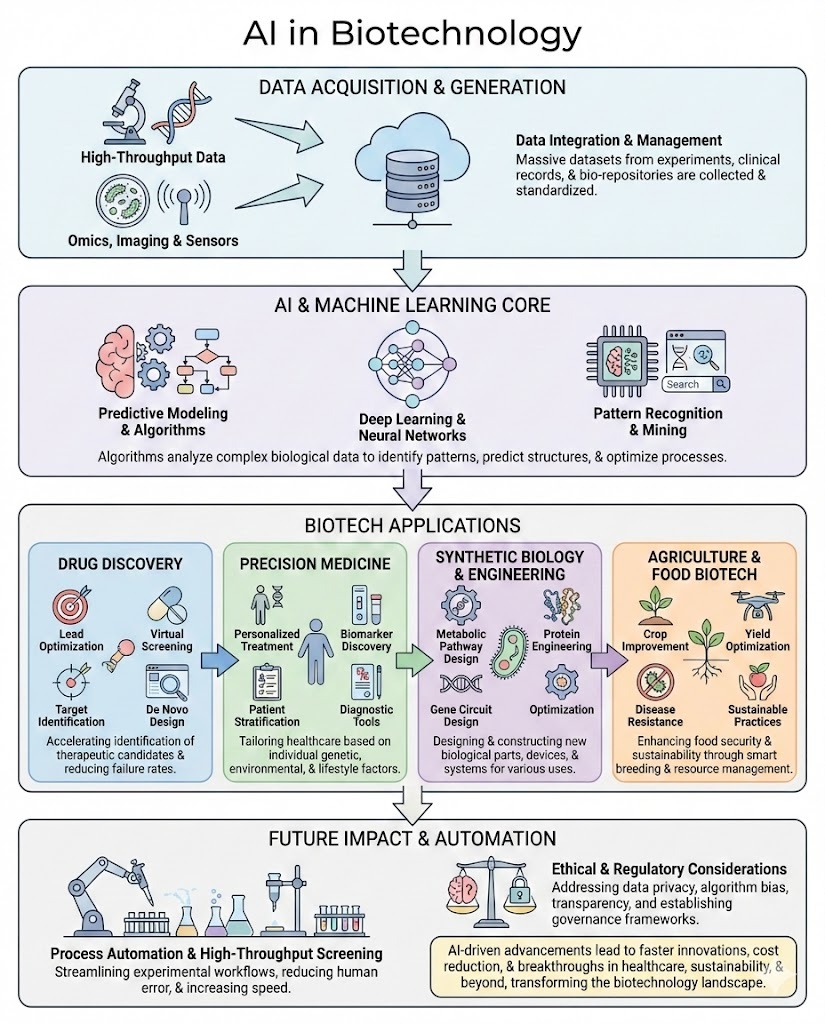
The biotechnology sector is undergoing a profound transformation driven by data, automation, and advanced computing. At the center of this shift is AI in Biotechnology, a field that blends computational intelligence with biological research to accelerate discovery, reduce costs, and improve accuracy across the entire life-science pipeline.
From drug development to genetic analysis and industrial bioprocessing, intelligent systems are becoming a core component of competitive biotech organizations. What was once dependent on years of trial and error is now increasingly guided by predictive modeling, large-scale data interpretation, and automated experimentation.
This article explores how AI in Biotechnology is applied today, the benefits it delivers, and what it means for the future of medicine, agriculture, and environmental science.
What AI in Biotechnology Really Means
AI in Biotechnology refers to the use of machine learning models, pattern recognition systems, and data-driven automation to analyze biological information and support scientific decision-making.
Biological systems are complex, nonlinear, and data-heavy. DNA sequences, protein structures, metabolic pathways, clinical trial results, and imaging datasets all generate enormous volumes of information. Traditional statistical methods often struggle to capture meaningful patterns at this scale.
Intelligent computational systems can process these datasets quickly, detect subtle relationships, and generate predictions that guide real-world experimentation.
Key Applications Across the Biotech Industry
AI in Biotechnology is already embedded in multiple stages of research and production.
Drug discovery and development
Developing a new drug typically takes over a decade and costs billions. Intelligent systems dramatically reduce this burden by:
-
Identifying promising drug targets from genomic data
-
Predicting how molecules will interact with proteins
-
Screening millions of compounds virtually before laboratory testing
-
Forecasting toxicity and side effects early in development
This approach shortens research timelines and improves the success rate of clinical trials.
Genomics and personalized medicine
Modern sequencing technologies produce massive genetic datasets. AI in Biotechnology enables:
-
Detection of disease-causing mutations
-
Identification of rare genetic disorders
-
Patient stratification for targeted therapies
-
Prediction of individual drug responses
This supports the shift toward personalized treatment plans tailored to a person’s unique genetic profile.
Protein structure prediction
Understanding protein folding is essential for designing therapies and vaccines. Advanced computational models can predict protein structures with remarkable accuracy, enabling:
-
Faster vaccine design
-
Development of enzyme therapies
-
Better understanding of disease mechanisms
This capability alone has reshaped molecular biology research.
Medical imaging and diagnostics
Biotech companies increasingly integrate intelligent image analysis to interpret:
-
Pathology slides
-
Microscopy images
-
MRI and CT scans
-
Cellular behavior in laboratory experiments
These systems detect abnormalities that may be missed by the human eye and support earlier, more accurate diagnosis.
Agricultural biotechnology
Beyond healthcare, AI in Biotechnology plays a growing role in agriculture:
-
Engineering crops resistant to drought and pests
-
Optimizing gene editing strategies
-
Predicting crop yields
-
Reducing chemical fertilizer use
This improves food security while minimizing environmental impact.
Industrial bioprocess optimization
Biotech manufacturing involves complex fermentation and cell culture systems. Intelligent software helps:
-
Monitor production in real time
-
Adjust conditions automatically for maximum yield
-
Detect contamination early
-
Reduce energy consumption and waste
The result is higher efficiency and lower operating costs.
Business Advantages of AI in Biotechnology
Organizations adopting intelligent technologies gain several strategic benefits:
-
Faster research cycles and shorter time to market
-
Lower R&D expenditure
-
Improved accuracy in experimental design
-
Better regulatory documentation and compliance tracking
-
Enhanced scalability of laboratory operations
For investors and partners, companies using AI in Biotechnology often demonstrate stronger pipelines and reduced risk profiles.
Challenges and Limitations
Despite its promise, AI in Biotechnology faces several practical challenges.
Data quality and availability
Models are only as good as the data used to train them. Inconsistent labeling, limited datasets, and experimental bias can affect performance.
Regulatory complexity
Biotech products must meet strict regulatory standards. Algorithms used in drug discovery or diagnostics must be transparent, validated, and auditable.
Integration with laboratory workflows
Many laboratories still rely on legacy systems. Integrating modern computational platforms requires infrastructure upgrades and staff training.
Ethical considerations
Handling genetic and patient data raises privacy concerns. Responsible governance and secure data management are essential.
Future Outlook
The influence of AI in Biotechnology will continue to grow as computing power increases and biological datasets expand.
Emerging trends include:
-
Fully automated laboratories using robotic experimentation
-
Real-time adaptive clinical trials
-
Digital twins of human organs for simulation testing
-
Predictive models for pandemic response
-
Decentralized biotech research platforms
As these systems mature, biotechnology will become more precise, more predictive, and more personalized than ever before.
Conclusion
AI in Biotechnology is no longer experimental. It is a foundational technology reshaping how biological research is conducted, how medicines are developed, and how complex biological systems are understood.
By combining large-scale data analysis with intelligent automation, the biotech industry gains faster discovery cycles, improved accuracy, and reduced operational costs. While challenges remain in regulation, data quality, and integration, the long-term benefits far outweigh the limitations.
For researchers, investors, and healthcare providers alike, understanding this technological shift is essential to staying competitive in the next generation of life sciences innovation.
Frequently Asked Questions
What is AI in Biotechnology used for?
AI in Biotechnology is used to analyze biological data, accelerate drug discovery, improve genetic research, optimize manufacturing processes, and support medical diagnostics. It helps scientists make faster and more accurate decisions across the research lifecycle.
How does AI improve drug development in biotechnology?
AI in Biotechnology identifies promising drug candidates, predicts molecular interactions, detects toxicity risks early, and reduces the need for expensive trial-and-error experiments. This shortens development timelines and increases success rates.
Is AI in Biotechnology safe for medical research?
When properly validated and regulated, AI in Biotechnology enhances safety by identifying errors, predicting adverse reactions, and improving quality control. Regulatory agencies require strict testing before systems are used in clinical settings.
What industries benefit most from AI in Biotechnology?
Healthcare, pharmaceuticals, agriculture, environmental science, and industrial manufacturing benefit significantly. Any sector that relies on biological data or living systems can gain efficiency and accuracy from intelligent computational tools.
Download PDF
Enter your email address to unlock the full PDF download.
Generating PDF...