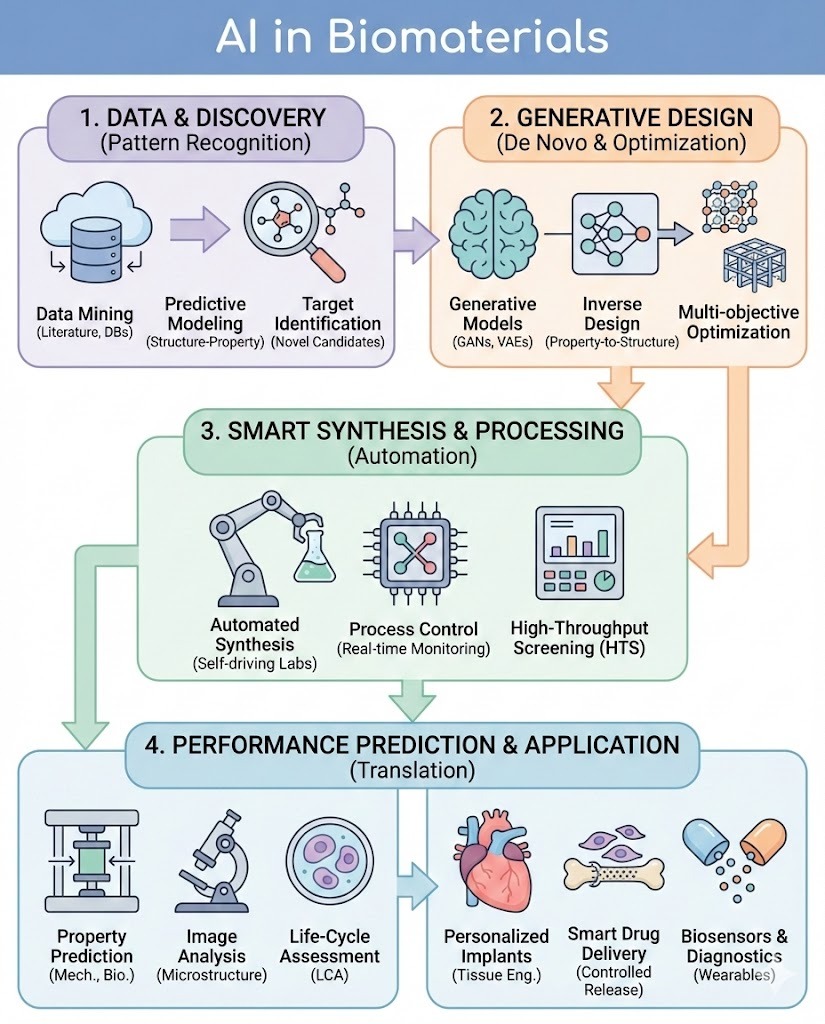
The convergence of data-driven technologies and material science is redefining how next-generation medical materials are discovered, designed, and deployed. Among the most influential developments in this space is AI in Biomaterials, a rapidly advancing field that is reshaping research workflows, reducing development timelines, and unlocking new levels of precision in healthcare innovation.
Biomaterials are the foundation of modern medical devices, implants, tissue scaffolds, and drug delivery systems. Traditionally, their development relied on lengthy trial-and-error experimentation and incremental testing. Today, computational intelligence introduces a more predictive, scalable, and efficient approach, helping researchers uncover patterns in complex biological and chemical systems that were previously difficult to model.
This article explores how AI in biomaterials is transforming the industry, key applications, advantages, challenges, and what lies ahead for this high-impact discipline.
What Are Biomaterials and Why They Matter
Biomaterials are substances engineered to interact with biological systems for medical purposes. They are used to replace, support, or enhance natural tissues and organs.
Common applications include:
-
Orthopedic and dental implants
-
Cardiovascular stents and valves
-
Wound dressings and tissue scaffolds
-
Drug delivery carriers
-
Diagnostic devices
The performance of a biomaterial depends on multiple factors, including biocompatibility, mechanical strength, degradation rate, and cellular response. Optimizing all these properties simultaneously is a complex task, which is where advanced computational methods provide substantial value.
How AI in Biomaterials Is Changing Material Discovery
AI in biomaterials enables researchers to analyze massive datasets generated from laboratory experiments, simulations, and clinical outcomes. Instead of manually testing thousands of material combinations, algorithms can identify promising candidates with high accuracy.
Key transformation areas include:
Accelerated Material Screening
Predictive models evaluate chemical compositions and structural properties to estimate:
-
Biocompatibility
-
Toxicity levels
-
Mechanical performance
-
Long-term stability
This allows scientists to narrow down viable materials in days rather than years.
Design of Custom Medical Materials
Patient-specific factors such as age, genetics, and medical history can influence how a material behaves in the body. AI-powered design systems help tailor biomaterials for personalized therapies, improving treatment outcomes and reducing complications.
Optimization of Tissue Engineering
In tissue regeneration, scaffold architecture is critical. AI in biomaterials assists in optimizing pore size, material stiffness, and degradation patterns to support cell growth and vascularization.
Improved Drug Delivery Systems
Smart modeling techniques help predict how nanoparticles or polymer carriers will release drugs over time, ensuring controlled dosage and minimizing side effects.
Benefits of AI in Biomaterials Development
The integration of intelligent computing into biomaterial science delivers measurable advantages across the research and commercialization pipeline.
-
Faster development cycles
-
Lower research and testing costs
-
Reduced reliance on animal testing
-
Improved material performance prediction
-
Higher success rates in clinical trials
-
Enhanced safety profiles
These benefits not only improve innovation speed but also make advanced therapies more accessible and affordable over time.
Real-World Applications Already Making an Impact
AI in biomaterials is no longer theoretical. It is actively shaping products and therapies in development and clinical use.
Notable examples include:
-
Smart orthopedic implants that adapt to mechanical stress patterns
-
Biodegradable stents optimized for controlled resorption
-
Neural interfaces with improved long-term compatibility
-
Cancer-targeting drug carriers designed through predictive modeling
-
Antimicrobial coatings for hospital equipment and surgical tools
Each of these applications demonstrates how data-driven material design leads to safer and more effective medical solutions.
Challenges and Limitations
Despite its promise, AI in biomaterials faces several obstacles that researchers and developers must address.
Data Quality and Availability
Accurate models depend on large, well-structured datasets. Inconsistent experimental methods and limited clinical data can restrict predictive accuracy.
Regulatory Complexity
Medical materials must meet strict regulatory standards. Explaining algorithm-driven design decisions to regulatory bodies remains an evolving challenge.
Interdisciplinary Skill Gaps
Successful implementation requires expertise in materials science, biology, and computational modeling. Bridging these disciplines takes time and investment.
Model Interpretability
Understanding why a model makes specific recommendations is essential for safety validation and scientific trust, yet not always straightforward.
Ongoing research and improved standards are steadily addressing these concerns.
The Future of AI in Biomaterials
The next decade is expected to bring deeper integration of AI in biomaterials across healthcare and biotechnology.
Emerging trends include:
-
Fully autonomous material discovery platforms
-
Digital twins of biological systems for testing material behavior
-
Real-time monitoring of implant performance using embedded sensors
-
Integration with 3D bioprinting technologies
-
Expansion into sustainable and eco-friendly biomaterials
As computing power increases and data ecosystems mature, the ability to design materials with near-perfect biological compatibility becomes increasingly realistic.
Conclusion
AI in biomaterials represents a fundamental shift in how medical materials are conceived and developed. By replacing slow trial-based research with predictive modeling and intelligent optimization, this approach accelerates innovation while improving safety and effectiveness.
From personalized implants to advanced drug delivery systems, the technology is enabling breakthroughs that directly enhance patient care and healthcare efficiency. While challenges remain in regulation, data quality, and interdisciplinary collaboration, the momentum behind this field is undeniable.
As healthcare continues its transition toward precision medicine and smart technologies, AI in biomaterials will play a central role in shaping the next generation of therapeutic solutions.
Frequently Asked Questions
What is AI in biomaterials?
AI in biomaterials refers to the use of advanced computational models to design, test, and optimize materials intended for medical and biological applications. It helps predict how materials will behave in the human body before physical testing begins.
How does AI improve biomaterial design?
It analyzes complex datasets to identify relationships between chemical composition, structure, and biological response. This enables faster discovery of safer and more effective materials while reducing costly laboratory experiments.
Is AI in biomaterials used in real medical products?
Yes. It is already applied in implant development, drug delivery systems, tissue engineering scaffolds, and antimicrobial coatings used in healthcare environments.
What industries benefit most from AI in biomaterials?
Healthcare, medical device manufacturing, pharmaceuticals, biotechnology, and regenerative medicine are the primary beneficiaries, with growing interest from environmental and sustainable material research sectors as well.