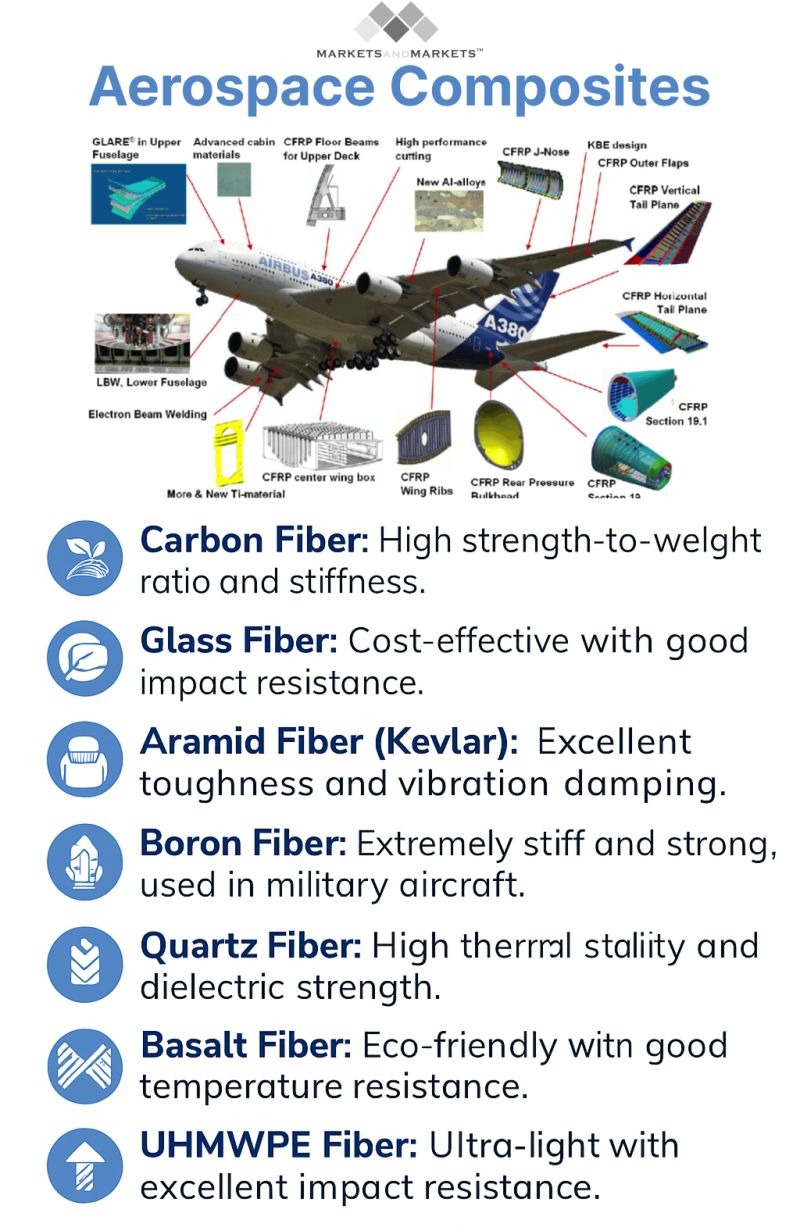
Aerospace composites have become a cornerstone of modern aircraft and spacecraft design. As the aerospace industry seeks lighter, stronger, and more fuel-efficient materials, composites are increasingly replacing traditional metals such as aluminum and steel. Today, these advanced materials play a vital role in improving performance, reducing emissions, and lowering lifecycle costs across commercial, military, and space applications.
What Are Aerospace Composites?
Aerospace composites are engineered materials formed by combining two or more distinct components to achieve superior mechanical and physical properties. Typically, these materials consist of reinforcing fibers embedded within a matrix material. The fibers provide strength and stiffness, while the matrix binds the fibers together and transfers loads between them.
Common reinforcing fibers include carbon fiber, glass fiber, and aramid fiber, while matrix materials often consist of epoxy, polyester, phenolic, or high-temperature resins. The resulting composites offer exceptional strength-to-weight ratios and durability.
Key Types of Aerospace Composites
Carbon Fiber Reinforced Polymers (CFRP)
CFRPs are the most widely used composites in aerospace applications. They offer outstanding stiffness, fatigue resistance, and low weight, making them ideal for primary structural components such as fuselages, wings, and tail assemblies.
Glass Fiber Reinforced Polymers (GFRP)
GFRPs provide good impact resistance and electrical insulation at a relatively lower cost. They are commonly used in radomes, fairings, and secondary aircraft structures.
Aramid Fiber Composites
Aramid-based composites are valued for their high impact resistance and toughness. These materials are often used in aircraft flooring, protective structures, and interior applications where durability is critical.
Ceramic Matrix Composites (CMCs)
CMCs are advanced materials designed to operate in extreme temperature environments. They are increasingly used in aircraft engines, exhaust components, and high-speed aerospace systems.
Applications of Aerospace Composites
Aerospace composites are used extensively across both commercial and defense sectors. Key applications include aircraft fuselages and wings, engine nacelles, helicopter rotor blades, spacecraft structures, satellites, unmanned aerial vehicles, and aircraft interiors. In modern commercial aircraft, composites can account for more than half of the total structural weight.
Advantages of Aerospace Composites
The growing adoption of composites in aerospace is driven by several advantages. These materials significantly reduce structural weight, which improves fuel efficiency and payload capacity. They also offer high strength, corrosion resistance, and superior fatigue performance. Additionally, composites enable greater design flexibility, allowing engineers to create complex aerodynamic shapes that enhance overall performance.
Manufacturing Technologies
Several manufacturing processes are used to produce aerospace composites. Autoclave curing remains a standard method for high-performance components. Resin transfer molding is widely used for complex geometries, while automated fiber placement improves precision and production efficiency. Out-of-autoclave processing is gaining popularity as it reduces manufacturing costs and energy consumption.
Challenges in Aerospace Composites
Despite their benefits, aerospace composites present certain challenges. High material and processing costs, complex inspection and repair procedures, and recycling limitations remain key concerns. Impact damage sensitivity is another issue that requires advanced inspection and monitoring techniques.
Future Outlook
The future of aerospace composites is highly promising. Rising demand for fuel-efficient aircraft, increasing space exploration activities, and advancements in material science are driving continued innovation. Emerging trends include recyclable composite materials, greater use of ceramic matrix composites in propulsion systems, and increased automation in manufacturing. These developments are expected to further expand the role of composites in next-generation aerospace platforms.
Conclusion
Aerospace composites have revolutionized the way aircraft and spacecraft are designed and manufactured. By offering unmatched combinations of lightweight construction, strength, and durability, these materials are essential to the future of aerospace engineering. As technology advances, composites will continue to shape safer, more efficient, and more sustainable aerospace systems.