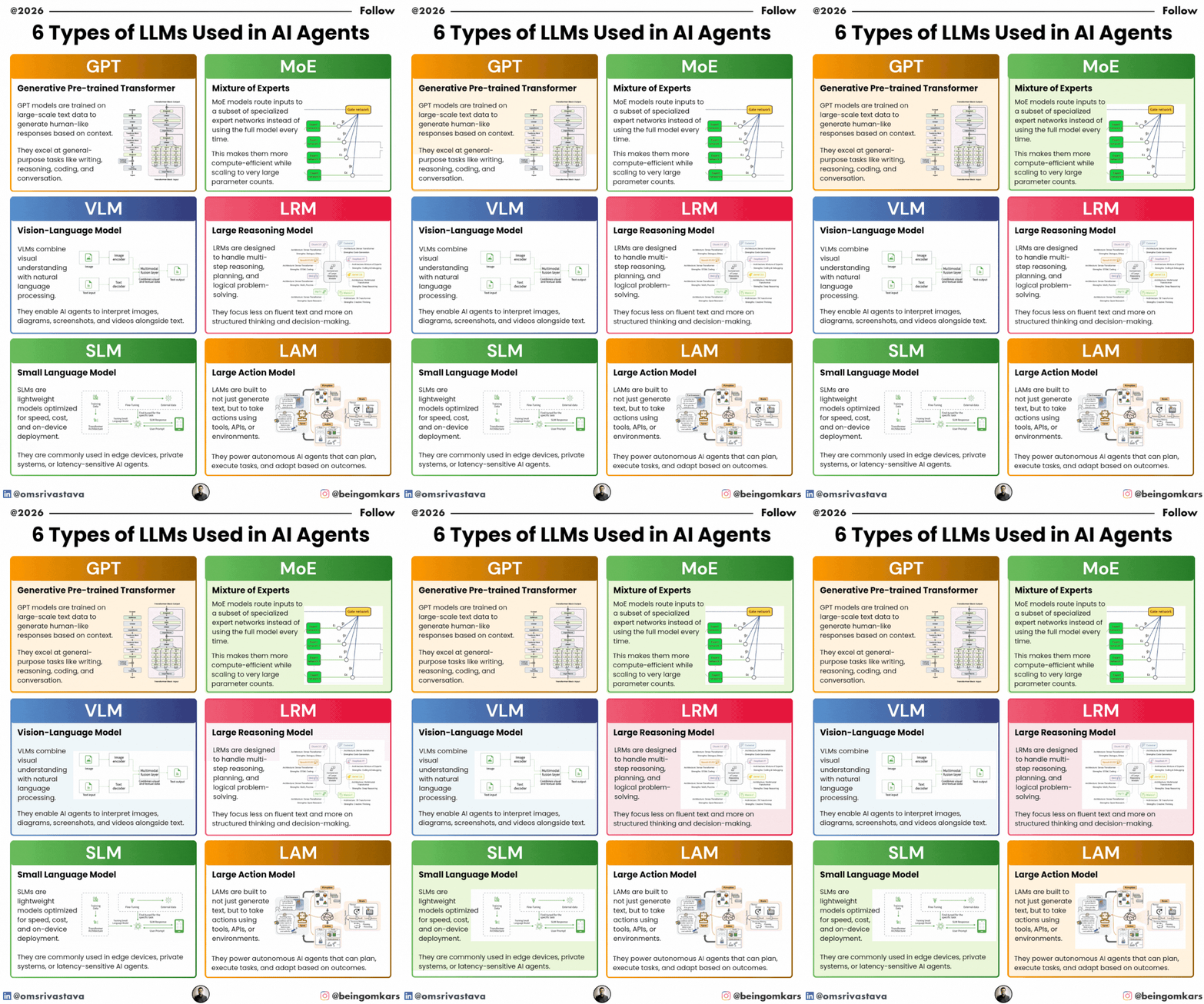
Not all Large Language Models (LLMs) are built the same—and that’s a good thing.
In modern AI agents, different types of LLMs play very different roles: some talk, some think deeply, some see images, and some actually do things.
If you’re building, evaluating, or just trying to understand agentic AI systems, here’s a clear breakdown of the six most important LLM types and where each one shines.
1. GPT – Generative Pre-Trained Transformer
What it is
The most widely known class of LLMs, trained on massive text datasets to generate human-like responses based on context.
Best for
-
Writing and summarization
-
Coding and debugging
-
Q&A and conversations
-
General reasoning
Use in AI agents
GPT-style models usually form the core brain of an agent—handling language understanding, response generation, and tool instructions.
Examples
-
GPT-4
-
GPT-3.5
-
Claude
2. MoE – Mixture of Experts
What it is
Instead of activating the entire model for every query, MoE models route each input to a small set of specialized “expert” networks.
Why it matters
This makes the system far more compute-efficient, even when the total parameter count is enormous.
Best for
-
Massive-scale deployments
-
High throughput with lower cost
-
Enterprise AI systems
Use in AI agents
-
Powering large agent fleets without exploding infrastructure costs
-
High-performance reasoning at scale
Architecture highlight
Input → Gating mechanism → Selected expert networks → Output
Examples
-
Mixtral
-
GPT-4 (widely rumored to use MoE internally)
3. VLM – Vision-Language Model
What it is
A model that understands images and text together, enabling true multimodal intelligence.
How it works
Image encoder + Text decoder → Multimodal fusion → Text output
Best for
-
Image and diagram interpretation
-
Screenshot analysis
-
Visual reasoning
-
Video understanding
Use in AI agents
-
Agents that can “see” dashboards, documents, UIs, or photos
-
Automation involving visual inputs
Examples
-
GPT-4V
-
Claude 3
-
Gemini
4. LRM – Large Reasoning Model
What it is
Models designed specifically for multi-step reasoning, planning, and logical decision-making—less about fluent text, more about thinking.
Best for
-
Complex problem-solving
-
Strategy and planning
-
Logical inference
-
Long-horizon decisions
Key focus
Structured reasoning over surface-level language fluency.
Use in AI agents
-
Task planning
-
Decision trees
-
Strategic execution flows
Examples
-
o1
-
o3-mini (reasoning-focused models)
5. SLM – Small Language Model
What it is
Compact, lightweight models optimized for speed, cost, and local deployment.
Best for
-
Edge devices
-
On-device AI
-
Privacy-sensitive environments
-
Low-latency applications
Architecture
Transformer-based, but heavily optimized for specific tasks.
Use in AI agents
-
Fast local decision-making
-
Offline or hybrid agents
-
Reducing cloud dependency
Examples
-
Phi-3
-
Llama 3.2 (small variants)
-
Gemini Nano
6. LAM – Large Action Model
What it is
LAMs go beyond text—they are built to take actions: calling APIs, using tools, interacting with environments, and adapting based on results.
Best for
-
Autonomous agents
-
Workflow automation
-
End-to-end task execution
Capabilities
-
Plan multi-step workflows
-
Execute tool calls
-
Observe outcomes and adapt
-
Loop until goals are met
Use in AI agents
This is the execution engine of agentic systems—the part that actually gets work done.
Examples
-
Action-oriented models in AutoGPT
-
Modern agent frameworks with tool-use capabilities
When to Use Each Type
-
GPT → General-purpose language tasks (chat, content, coding)
-
MoE → Massive scale with compute efficiency (enterprise AI)
-
VLM → Multimodal tasks (image + text understanding)
-
LRM → Deep reasoning, planning, and logic
-
SLM → Edge, low-latency, private deployments
-
LAM → Autonomous execution and workflow automation
Final Thought
Modern AI agents are rarely powered by just one model. The real magic happens when multiple LLM types work together—one to reason, one to see, one to act, and another to respond fluently.
That’s the future of agentic AI: specialized intelligence, orchestrated as a system 🤖✨